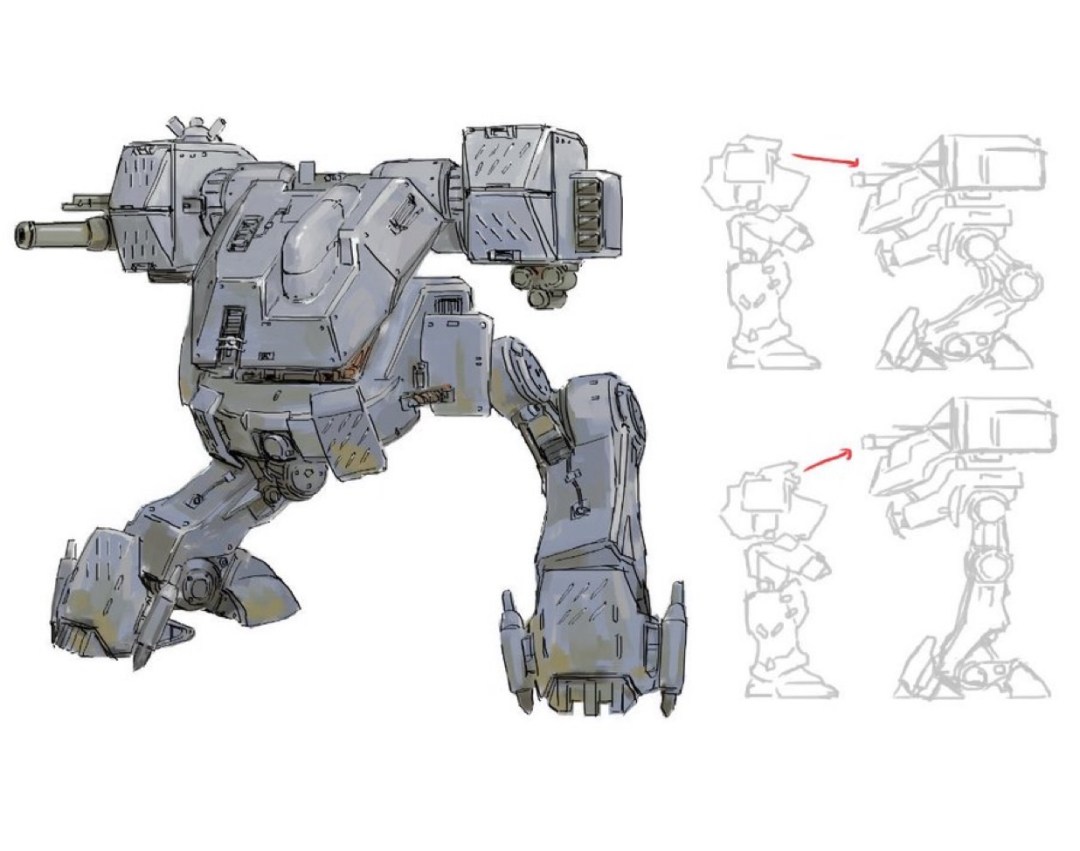
The SERAPH unit’s footsteps echoed like thunder through the narrow streets of the Kharāi serf district. Fifteen feet of digitigrade war machine, hunched forward in that predatory stance that made civilians scatter like frightened insects. The pilot’s mission was textbook: raid the safe house, eliminate the Debol Obektam cell, send a message about what happens to terrorists who threaten Dominion stability.
What the pilot didn’t expect was the matte-gray humanoid that smashed through the warehouse wall in an explosion of concrete and rebar.
The Golem moved with liquid grace, its consciousness-transferred operator drawing on decades of combat experience as plasma bolts deflected off the energy shield projecting from its left arm. Behind it, revolutionary cell members extracted through the breach it had torn in the building’s structure. The SERAPH’s overwhelming firepower meant nothing when its target could shrug off direct hits and punch through any cover.
Welcome to mechanized warfare in the age of The Name’s Dominion, where three very different philosophies of violence compete for the galaxy’s future.
The Players
The math is simple and brutal: 70 trillion subjects across ten thousand worlds held down by divine authority, fear, and the promise of eternal damnation for those who resist the god-king’s will. For nearly three millennia, this equation worked. Serfs and slaves knew their place. The Anathema stayed anathematized. Order prevailed.
Then whispers started spreading of Sutmankah—a woman prophesied to overthrow the Dominion. Suddenly, revolutionary cells like Debol Obektam began sprouting across the galaxy like spores after rain. Worse, they had backing from an unexpected source: the very Consortium clans the Dominion depended on to keep their gray market economy functioning.
Now the Mešvi outcasts who run the galaxy’s actual financial systems are funding revolution while publicly maintaining their role as despised pariahs. The Dominion faces an enemy that can’t be simply crushed because destroying them means destroying the economic infrastructure that keeps 70 trillion people alive.
This is war fought with quarterly reports and consciousness-transferring assassins, where the most dangerous battles happen in boardrooms and data centers. But when the shooting starts, it comes down to machines.
SERAPH: Divine Wrath on Two Legs
The Selective Enforcement Rapid Assault Platform – Heavy represents everything the Dominion believes about power: overwhelming, implacable, and psychologically devastating. At twelve to fifteen feet tall, a SERAPH doesn’t just outgun civilian resistance—it crushes the will to resist entirely.
The digitigrade stance serves pure intimidation psychology. Those reverse-jointed legs and forward-leaning predator posture trigger deep evolutionary responses in human targets. This isn’t a machine; it’s a mechanical apex predator stalking through your neighborhood, and every survival instinct you possess knows it.
Standard loadout includes adjustable blaster arrays for crowd control, heavy plasma weapons for hardened targets, and kinetic systems when reliability matters more than elegance. Graviton grenades provide area denial, while the repulsor systems allow tactical leaps that turn urban terrain into a hunting ground.
But the real weapon is presence. When a SERAPH stalks through a serf district, word spreads faster than the machine itself. Riots dissolve into scattered flight. Underground meetings become public confessions. The mere possibility that one might appear keeps entire sectors compliant.
SERAPHs excel at their primary mission: keeping the Anathema terrified. They’re built for asymmetric warfare against civilians who have nothing but desperation and improvised weapons. Against Debol Obektam cells armed with pulse rifles and tungsten-core ammunition, they remain devastatingly effective.
Against Consortium Golems, the equation changes entirely.
Golem: Precision in Silicon and Steel
Where SERAPHs represent overwhelming force, Golems embody surgical precision evolved over centuries of necessity. When you’re an outcast people operating in the shadows of a theocratic empire, you can’t afford crude solutions. You build better.
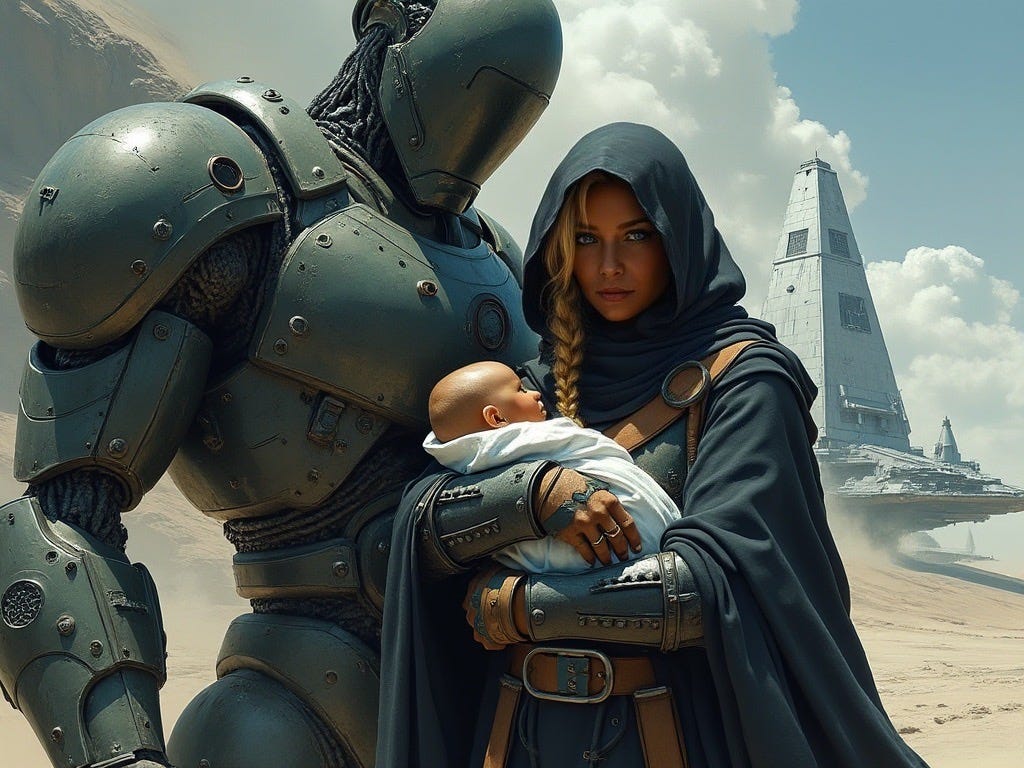
The Mark V Golem chassis stands just over two meters—barely half a SERAPH’s height—but houses technology the Dominion can’t replicate. Silicon carbide ceramics and nanocomposite alloy construction provide protection that makes the platform nearly indestructible, while a nanostructured klashium tungstenite core safeguards the organic nervous system that serves as the interface between machine and consciousness.
Because that’s what makes Golems truly dangerous: the pilot isn’t just wearing a suit or controlling a vehicle. A Shellycoat operative abandons their birth body entirely, transferring consciousness into the machine’s biological components. The result is reflexes and spatial awareness no baseline human could match, enhanced by decades or centuries of accumulated combat experience.
The humanoid configuration allows interaction with human-scale environments while maintaining full combat capability. Suppressed weapons systems integrated into the chassis provide firepower without sacrificing the delicate manipulation required for infiltration work. Energy shields can deflect incoming fire while the operator picks a lock or accesses a computer terminal.
But the real advantage is adaptability. A Shellycoat can spend months infiltrating a facility as a maintenance worker, then transfer into a Golem for the actual operation, bringing perfect familiarity with the target environment into a platform capable of walking through walls. They represent institutional knowledge made flesh and steel.
The Revolutionary Wild Card
Debol Obektam changed the rules by refusing to play by them. Traditional revolutionary cells face the SERAPH problem: overwhelming government firepower deployed against lightly armed insurgents. The historical solution involves hiding, running, and accepting massive casualties for minimal gains.
But when Consortium clans started covertly funding revolutionary operations, suddenly insurgents had access to technology that could fight back. A Golem supporting a Debol Obektam extraction doesn’t just even the odds—it flips them entirely.
SERAPHs designed for crowd control struggle against peer-level opposition. Their psychological warfare capabilities mean nothing to a consciousness-transferred operator who doesn’t experience fear the way baseline humans do. Their overwhelming firepower becomes academic when the target can absorb direct hits and tear through any cover the SERAPH might hide behind.
More importantly, Golem support transforms the strategic picture. Revolutionary cells can now conduct operations that were previously impossible: precision strikes against hardened targets, extractions from maximum security facilities, intelligence gathering that bypasses every conventional security measure. The Dominion’s standard counterinsurgency doctrine assumes the government holds overwhelming technological superiority. Remove that assumption, and centuries of tactical doctrine becomes obsolete.
The Real War
These machines represent more than military hardware—they’re competing visions for humanity’s future written in weapons specifications and armor plating.
SERAPHs embody the Dominion’s core philosophy: order through overwhelming force, compliance through terror, stability through the systematic crushing of hope. They’re perfect for maintaining a system where 70 trillion people accept their subjugation because resistance seems impossible.
Golems represent the Consortium alternative: precision over power, adaptability over overwhelming force, intelligence over intimidation. They’re tools for people who survive by being smarter, faster, and more flexible than their oppressors. Every technical specification reflects the reality of outcast life—you can’t afford waste, inefficiency, or second chances.
But the rise of Debol Obektam and similar revolutionary movements suggests a third option: that neither overwhelming force nor surgical precision matters when enough people decide the current system is unacceptable. Technology becomes irrelevant when the foundation of power itself cracks.
The question isn’t who builds better war machines. It’s whether machines can hold together a galaxy where millions believe a prophesied woman and her child will soon overturn three millennia of divine rule.
When the shooting starts, tungsten doesn’t care about propaganda. But tungsten also can’t stop an idea whose time has come.
The real war is just beginning.
Ryan Williamson is a former U.S. Army Cavalry Scout who writes speculative fiction like the Doomsday Recon trilogy and the upcoming Dark Dominion sequence, wrestling with what makes us heroes or monsters. When he’s not crafting worlds or designing mobile weapons platforms, he chases five-star reviews, motorcycles, and other dopamine hits.
Discover more from The Annex
Subscribe to get the latest posts sent to your email.

 The Annex