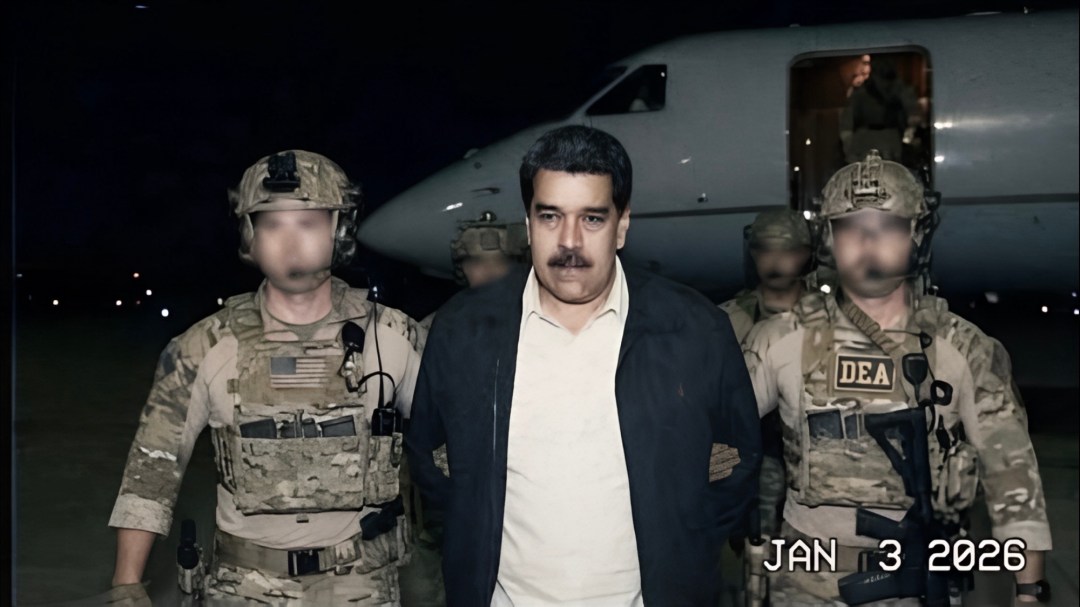
On January 3, 2026, the United States launched airstrikes across northern Venezuela, killing at least eighty people including thirty-two Cuban military personnel and an unknown number of civilians, then extracted sitting president Nicolás Maduro and his wife from a fortified compound in Caracas and flew them to New York to face federal charges. More than 150 aircraft participated in what the administration codenamed Operation Absolute Resolve. President Trump announced the United States would “run” Venezuela until a transition of power could be arranged.
The administration has offered a rotating set of justifications for this action: it was merely executing an existing arrest warrant; it constituted law enforcement rather than military invasion; it qualified as self-defense against drug trafficking; it followed the precedent of Panama in 1989; congressional notification would have compromised operational security; Maduro’s illegitimacy stripped him of sovereign protections; and besides, at least we’re getting the oil this time.
Every one of these arguments fails on its own terms. They fail legally, they fail constitutionally, and they fail logically. What follows is a systematic examination of each claim against the actual law, the administration’s own prior statements, and the expert consensus of international law scholars. This isn’t a partisan document—the sources include Reagan-era legal memos, Bush administration precedents, and analysis from scholars across the political spectrum.
The question of whether Maduro’s a bad man (he is) is irrelevant to whether Trump acted lawfully (he didn’t).
This is all rather depressing, so to make it more fun break out your favorite beverage and take a shot each time you spot a logical fallacy.
1. “We’re Just Enforcing an Existing Indictment”
Secretary of State Marco Rubio laid out the core framing, calling the operation “at its core an arrest of two indicted fugitives of American justice.” Defense Secretary Pete Hegseth called it a “joint military and law enforcement raid,” and General Dan Caine termed it an “apprehension mission.” Senator Tom Cotton told CBS the operation “was designed to remove Nicholas Maduro because he was a US indicted drug trafficker.”
The existence of an indictment doesn’t grant the executive branch the power to invade sovereign nations. If it did, the entire architecture of congressional war powers would collapse into irrelevance. As Reason magazine’s legal analysis noted, the executive branch makes indictments, and if indictments can authorize military strikes in foreign nations, there’s no need for Congress to be involved at all. Why did President George W. Bush bother going to Congress for an Authorization for the Use of Military Force to invade Iraq? It would have been much easier to simply have the attorney general indict Saddam Hussein, then send in the troops.
International law scholars Michael Schmitt, Ryan Goodman, and Tess Bridgeman explain that enforcement jurisdiction is strictly limited to a state’s own territory. Without Venezuela’s consent, exercising enforcement jurisdiction on their territory violates Venezuelan sovereignty and usurps “an inherently governmental function” exclusively enjoyed by Venezuela. The same experts note that as a sitting head of state, Maduro enjoyed absolute immunity from foreign enforcement jurisdiction under customary international law. This immunity bars any form of enforcement by another state regardless of any crimes he may have committed.
Jeremy Paul, professor of law and former dean of Northeastern University School of Law, put it plainly: “Allowing the seizure of a foreign leader in his own country to execute a warrant basically means that we are granting U.S. grand jurors, along with prosecutors, the power to declare war.”
The indictment existed for nearly six years. If it justified military action, it justified military action in 2020. The timing of this operation had nothing to do with law enforcement and everything to do with the political calendar.
2. “It’s Law Enforcement, Not an Invasion”
Secretary of State Marco Rubio told NBC’s Meet the Press: “This was not an attack on Venezuela. This was a law enforcement function to capture an indicted drug trafficker.” He added that congressional approval wasn’t necessary “because this was not an invasion. This was not an extended military operation.” The Pentagon’s involvement, Rubio explained, was required only because Venezuela possesses anti-aircraft missiles that “could shoot down those helicopters.”
This argument performs a rhetorical sleight-of-hand so brazen it borders on performance art. The administration asks us to accept that 150 aircraft conducting airstrikes across a sovereign nation’s capital, killing eighty people, destroying military installations, and extracting a sitting head of state somehow falls outside the definition of “military operation” because the paperwork says “arrest warrant” instead of “declaration of war.”
International law doesn’t permit this reframing. Expert analysis explains that the intervention came from the highest U.S. authority, targeted Venezuela’s acting head of state, and was executed against a background of hostile relations. “It is hard to see how this can be anything other than a ‘use of force’ within the meaning of article 2(4) of the UN Charter.” Leading international law scholars note that the lethal force employed was unlawful even accepting the law enforcement framing. Resort to deadly force during law enforcement operations is only lawful when necessary against an immediate threat of death or grievous bodily injury. The Venezuelan strikes were “primarily preventive and anticipatory in character,” killing at least eighty people in what “falls far outside the scope of permissible lethal measures during a law enforcement operation.”
Claire Finkelstein, professor of law at the University of Pennsylvania, told Al Jazeera there was no “immediate threat” to the United States that would justify bypassing Congress. “It was an act of war against Venezuela, and we did not have the kind of self-defence justification that would normally justify bypassing Congress.”
The administration’s own prior statements undermine its current position. In November, White House Chief of Staff Susie Wiles told Vanity Fair that land strikes in Venezuela would require congressional approval: “If Trump were to authorize some activity on land, then it’s war, then we’d need Congress.” Days later, administration officials privately told Congress the same thing. What changed between November and January wasn’t the law. What changed was the administration’s willingness to follow it.
Calling an invasion “law enforcement” doesn’t make it law enforcement. The semantic game here is transparent. Define your terms narrowly enough and nothing is ever a war. But the Constitution doesn’t grant the executive branch the power to redefine military action out of existence through creative labeling, and international law doesn’t permit sovereignty violations simply because the aggressor nation prefers gentler terminology.
3. “Self-Defense Against Drug Trafficking”
A White House spokesperson claimed the strikes were “conducted against the operations of a designated terrorist organization and was taken in defense of vital U.S. national interests and in the collective self-defense of other nations.” A classified Justice Department memo argues that force may be used against cartels because they pose an “imminent threat to Americans.” In a statement to the UN Security Council in October, the U.S. representative said, “President Trump determined these cartels are non-state armed groups, designated them as terrorist organizations, and determined that their actions constitute an armed attack against the United States.”
This is the most legally creative argument the administration has offered, and it falls apart the moment you apply any scrutiny. Leading international law experts state flatly: “The claim that drug trafficking, or State involvement in such trafficking, constitutes an ‘armed attack’ sufficient to justify a forcible response in self-defense has no support in customary international law or State practice.” The relationship between drug trafficking and deaths from drugs is far too attenuated to qualify. The drugs must be transported, distributed, sold on the streets by individuals unrelated to the original cartels, and willingly purchased. Almost all buyers survive. Deaths that occur run contrary to cartel interests because they deprive the market of customers.
UN human rights experts stated in December 2025: “International law does not permit the unilateral use of force abroad to fight terrorism or drug trafficking. Attacks on organised crime groups in foreign territory would violate the other country’s sovereignty and could amount to an illegal use of force under the United Nations Charter and customary international law.” The same statement noted that the boat strikes “amount to violations of the right to life” and called for investigations and accountability.
Just Security’s expert Q&A is unequivocal: “Despite the Trump administration’s claims, and even if all of the claimed facts were true, there has been no ‘armed attack’ (or imminent threat of armed attack) by any drug cartel or criminal gang against the United States. Trafficking drugs into a country cannot alone constitute an armed attack that would trigger the right of self-defense in response.”
The administration is attempting to stretch the definition of “armed attack” beyond recognition. If drug trafficking qualifies, then any cross-border harm qualifies. Pollution. Cyberattacks. Economic competition. The limiting principle vanishes entirely, and with it any meaningful constraint on unilateral military action.
4. “Better Than Iraq—At Least We Get the Resources”
Defense Secretary Pete Hegseth told CBS the Venezuela intervention was the “exact opposite” of Iraq. “We spent decades and decades and purchased in blood, and got nothing economically in return, and President Trump flips the script.” Through strategic action, Hegseth claimed, the U.S. can ensure access to “additional wealth and resources, enabling a country to unleash that without having to spend American blood.” Trump himself stressed oil as a key motivator, saying American oil companies would modernize Venezuela’s production, invest billions, and that “the biggest beneficiary are going to be the people of Venezuela.”
This isn’t a legal defense. It’s an admission. The administration is openly stating that resource extraction is a primary motivation for the operation, apparently unaware that using force to acquire assets is itself unlawful under international law. International law experts note the action doesn’t qualify as self-defense no matter how unlawful any prior expropriation of American assets may have been. Non-forcible avenues exist, including arbitration and countermeasures under the law of state responsibility.
PolitiFact fact-checkers consulted experts who pointed to the Annex to the Hague Convention of 1907, which states that “private property must be respected and cannot be confiscated” and that “pillage is formally forbidden.” Terrorism analyst Daveed Gartenstein-Ross observed that if “to the victors go the spoils” were legal doctrine, Saddam Hussein should have been able to keep Kuwait City after he invaded.
The Iraq comparison is revealing in ways the administration doesn’t intend. The argument isn’t that this action is legal where Iraq wasn’t. The argument is that Iraq was insufficiently profitable and this one will be better. That’s not a legal theory. That’s a confession dressed up as strategy.
5. “Congress Leaks”
Trump justified not notifying Congress beforehand by saying “Congress has a tendency to leak. This would not be good.” Secretary of State Marco Rubio said members weren’t notified in advance because “notifying members ahead of the action could have jeopardized the mission” and that “this was not the kind of mission that you can do congressional notification on.”
The Constitution isn’t optional when it’s inconvenient. The document doesn’t include an exception for operations the president would prefer to keep secret. Senator Tim Kaine stated: “The Constitution is clear that the U.S. doesn’t engage in military action or war without a vote of Congress except in cases of imminent self-defense. The Constitution is absolutely clear on that.”
William Burke-White, expert on U.S. foreign relations law at the University of Pennsylvania, explains that the Constitution divides war powers between Congress and the President, with Article I, Section 8 vesting in Congress the power “to declare War.” In the absence of statutory authorization or an imminent armed threat to the United States, “these operations constitute an unconstitutional exercise of the war power—precisely the form of unilateral presidential action the constitutional design was intended to prevent.”
The administration’s own prior position makes this defense untenable. In November, Susie Wiles told Vanity Fair that land strikes would require Congress. Days later, administration officials told Congress the same thing privately. They knew they needed authorization. They proceeded without it anyway, and now they’re arguing that the requirement itself doesn’t apply because compliance would be inconvenient.
Congress has mechanisms for classified briefings. The Gang of Eight exists precisely for situations requiring operational secrecy. The administration didn’t use these mechanisms because it didn’t want congressional input, not because congressional input was impossible.
6. “Maduro Is Illegitimate, So Sovereignty Doesn’t Apply”
U.S. Attorney General Barr indicated in 2020 that Maduro didn’t qualify for head-of-state immunity “because the United States does not recognize him as the president of Venezuela. Instead, the United States and fifty-seven other countries recognize Interim President Juan Guaidó.”
U.S. recognition policy doesn’t override customary international law. International law experts explain: “Even though the US does not recognize the Maduro government as legitimate, international law provides that the relevant officials to grant consent are those of the government that exercises ‘effective control’ over the territory—in this case, officials in the Maduro administration.” Withdrawing recognition doesn’t remove head of state immunity or sovereignty protections.
Legal analysis notes that U.S. courts will presumably set aside Maduro’s head of state immunity because the Trump administration doesn’t recognize his presidency, and American courts probably won’t concern themselves with the manner of his arrest via extraterritorial law enforcement in a foreign state. But the fact that U.S. courts may decline to apply international law doesn’t mean international law doesn’t exist. It means we’re choosing to violate it.
The logical extension of this argument is that any nation can invade any other nation whose government it doesn’t recognize. Russia doesn’t recognize the legitimacy of Ukraine’s government. China doesn’t recognize Taiwan. The principle the administration is asserting has no limiting factor beyond the willingness to use force.
7. “The Panama Precedent”
The Trump administration pointed to the 1989 Panama operation to capture Manuel Noriega as precedent. A Justice Department Office of Legal Counsel memo from 1989, written by William Barr, said a president had “inherent constitutional authority” to order the FBI to take people into custody in foreign countries, even if it violated international law to do so.
The UN General Assembly condemned the 1989 Panama operation as “a flagrant violation of international law.” Citing a condemned action as precedent for a new action doesn’t make the new action legal. It just means we’ve done this before and gotten away with it.
More importantly, the situations aren’t comparable. The U.S. claimed to be acting in Panama by invitation of the rightful head of state. Panama’s National Assembly had declared a state of war against the U.S. Forces under Noriega’s command had killed an unarmed American serviceman, wounded another, arrested and brutally beat a third, and brutally interrogated his wife while threatening her with sexual abuse. President George H.W. Bush told Congress the operation “was welcomed by the democratically elected government of Panama” and noted that “General Noriega’s reckless threats and attacks upon Americans in Panama created an imminent danger to the 35,000 American citizens in Panama.”
None of those factors exist here. There was no invitation from a rival government claiming legitimacy. There was no declaration of war by Venezuela. There were no attacks on American citizens in Venezuela. There was no imminent danger to Americans. The administration is citing Panama while omitting every element that distinguished Panama from pure aggression.
8. “Democrats Are Just Defending Drug Dealers”
NPR analysis notes that “Trump and Republicans are very good at trying to put Democrats in a position of seemingly defending drug dealers and bad people.” On Fox News, panelists mocked Democrats’ legal arguments and focused on how few Venezuelans were defending Maduro and on his 2020 indictment. The political strategy is transparent: force opponents into the position of appearing to defend a dictator.
This is a deliberate conflation of two separate questions. The first question is whether Maduro is a bad person who has done bad things. The answer is yes. He rigged elections, impoverished his people, and ran a corrupt regime. The second question is whether the United States acted lawfully in invading Venezuela to capture him. The answer is no.
Pointing out that an action is illegal isn’t the same as defending the target of that action. Senator Tim Kaine explained the actual stakes: “We can’t, with a straight face, make the argument that we support the sovereignty of nations if we’re willing to engage in a unilateral, presidentially declared war against Venezuela. And thus he is really undercutting US moral and stance for an international rule of law where nations can invade each other willy nilly just because a president decides it’s a good idea to do so.”
The Constitution gives Congress the sole authority to declare war. This isn’t a Democratic position or a Republican position. It’s what the document says. Reason magazine, hardly a left-wing outlet, stated it plainly: “That separation of powers is fundamental to American democracy—not an optional arrangement for presidents to discard when it is politically or logistically inconvenient.”
Representative Thomas Massie, a Republican from Kentucky, posted his own objection: “If this action were constitutionally sound, the Attorney General wouldn’t be tweeting that they’ve arrested the President of a sovereign country and his wife for possessing guns in violation of a 1934 U.S. firearm law.” Representative Marjorie Taylor Greene questioned Trump’s justification as well, asking why, if this is truly about drug traffickers, the administration hasn’t taken action against Mexican cartels.
The “defending drug dealers” framing is designed to prevent exactly this kind of scrutiny. It’s not an argument. It’s a rhetorical trap.
9. “Strong Executive / Hamiltonian Tradition”
Some analysis frames the Venezuela operation as part of a broader “reconfiguration of the presidency’s relations to the legislative and judicial branches of power, in line with the Hamiltonian tradition of a strong and unifying executive branch.” Trump himself dismissed concerns, saying “The Democrats, maybe they’ll take a shot… all they do is complain. They should say, ‘great job.’ They shouldn’t say, ‘Oh gee, maybe it’s not constitutional.’ You know, the same old stuff that we’ve been hearing for years and years and years.”
Congress itself has stated its position. S.J.Res.90 reads: “Congress has the sole power to declare war under article I, section 8, clause 11 of the United States Constitution. Congress has not yet declared war upon Venezuela or any person or organization within Venezuela, nor enacted a specific statutory authorization for use of military force within or against Venezuela.”
The Supreme Court has interpreted constitutional war powers provisions to grant the President some independent authority to use limited force to protect U.S. personnel or interests abroad, but not to initiate sustained hostilities absent congressional authorization. William Burke-White concludes that in the absence of statutory authorization or an imminent armed threat to the United States, “these operations constitute an unconstitutional exercise of the war power—precisely the form of unilateral presidential action the constitutional design was intended to prevent.”
The Hamiltonian tradition argument is an appeal to a contested interpretation of constitutional history as though it were settled law. It isn’t. The Founders deliberately divided war powers because they understood the danger of concentrating the power to initiate hostilities in a single individual. Hamilton himself, in Federalist No. 69, distinguished the president’s authority as commander in chief from the British monarch’s power to declare war, noting that the president’s power “would amount to nothing more than the supreme command and direction of the military and naval forces” while “the power of the British king extends to the declaring of war.”
Treating constitutional constraints as partisan complaints to be dismissed doesn’t make them disappear. It just makes the violation more brazen.
The administration has offered at least nine distinct justifications for the Venezuela operation, and each one fails spectacularly. The indictment didn’t authorize military force. The operation wasn’t law enforcement in any meaningful sense. Drug trafficking doesn’t constitute an armed attack under international law. Resource extraction is an admission of unlawful motive, not a defense. Congressional leaks don’t suspend the Constitution. Non-recognition doesn’t eliminate sovereignty. Panama isn’t precedent for anything except prior lawlessness. Criticizing illegal action isn’t defending drug dealers. And the Hamiltonian tradition doesn’t override the text of Article I.
“Courts won’t enforce it” doesn’t mean it wasn’t a violation of the Constitution. “Obama did it too” doesn’t mean it wasn’t a violation. “It worked” doesn’t mean it wasn’t a violation. “Maduro was bad” doesn’t mean it wasn’t a violation.
Article I, Section 8: Congress declares war.
They didn’t. The administration’s own chief of staff said land strikes would require Congress.
Trump conducted land strikes anyway.
What happened on January 3, 2026, was an act of war conducted without congressional authorization against a sovereign nation that posed no imminent threat to the United States. The administration has offered rhetorical justifications dressed up as legal arguments, but the expert consensus from scholars across the political spectrum is unambiguous. This operation was illegal under both domestic and international law.
The constitutional violation isn’t ambiguous or debatable. The administration’s own chief of staff said in November that land strikes would require congressional authorization. Days later, administration officials told Congress the same thing privately. Then they conducted land strikes anyway and argued the requirement doesn’t apply because compliance would be inconvenient. Article I, Section 8 isn’t a suggestion. It isn’t a norm. It’s the explicit text of the Constitution, and this administration has demonstrated that the text means nothing to them when it conflicts with what they want to do.
The domestic precedent this sets should terrify anyone who thinks beyond the current news cycle. Every power claimed by this administration becomes a power available to every future administration. If executive-branch indictments can authorize military strikes in foreign nations, any president can manufacture justification for any war. If “law enforcement” labels can transform invasions into something that doesn’t require congressional approval, the war powers clause is dead letter. If “Congress leaks” is sufficient reason to bypass constitutional requirements, those requirements no longer exist in any meaningful sense. The ratchet only turns one direction. These tools don’t disappear when the other party takes power. They get inherited, expanded, and normalized.
The international precedent matters too. If the United States can invade any nation whose leader we’ve indicted, whose government we don’t recognize, whose resources we want, then the rules-based international order the United States helped build after World War II is functionally dead. Russia can cite this operation to justify action against governments it considers illegitimate. China can cite it regarding Taiwan. The UN Secretary General’s spokesperson called it “a dangerous precedent.” Brazil, Spain, Chile, Colombia, Mexico, and Uruguay issued a joint statement expressing “profound concern and firm rejection.” Even allies like Norway stated the operation was “not in accordance with international law.” Any nation with sufficient military power can now do whatever it wants to any nation without sufficient military power to resist. That’s not a world order. That’s the law of the jungle with better press releases.
But the deepest rot isn’t in the administration’s arguments. It’s in the response. Self-proclaimed patriots are celebrating this. They’re cheering an executive branch that wages war without constitutional authority, dismisses congressional oversight as inconvenient leaking, and treats the separation of powers as “the same old stuff we’ve been hearing for years.” The Constitution they claim to revere explicitly reserves the power to declare war to Congress. That isn’t interpretation. It isn’t a living document question. It’s the plain text, written by founders who understood exactly why they didn’t want a single individual deciding when the nation goes to war. And these patriots are cheering its violation because their team is the one doing it.
That’s not patriotism.
The Republic doesn’t fall because foreign enemies breach the walls. It falls because the people inside stop caring whether the walls exist. It falls when constitutional constraints become inconveniences to be dismissed, when the rule of law becomes a weapon wielded against enemies rather than a principle applied to everyone, and when “we won” matters more than “was it legal?”
Meanwhile, people are treating an illegal invasion like it’s the fucking Super Bowl.
For those of you playing Spot the Logical Fallacy at home, here’s the answer key:
- False Equivalence, Special Pleading, Circular Reasoning
- Motte and Bailey, Equivocation, Moving the Goalposts, Semantic Games
- False Cause, Definitional Retreat, Composition Fallacy
- Tu Quoque (Whataboutism), Two Wrongs Make a Right, Appeal to Consequences
- Ad Hoc Reasoning, Moving the Goalposts, False Dilemma, Begging the Question
- Red Herring, Non Sequitur, Conflation
- False Analogy, Cherry Picking, Selective History
- Ad Hominem, Strawman, Appeal to Emotion, Poisoning the Well, False Dilemma
- Appeal to Tradition, Appeal to Authority, Historical Revisionism, Equivocation
Discover more from The Annex
Subscribe to get the latest posts sent to your email.

 The Annex