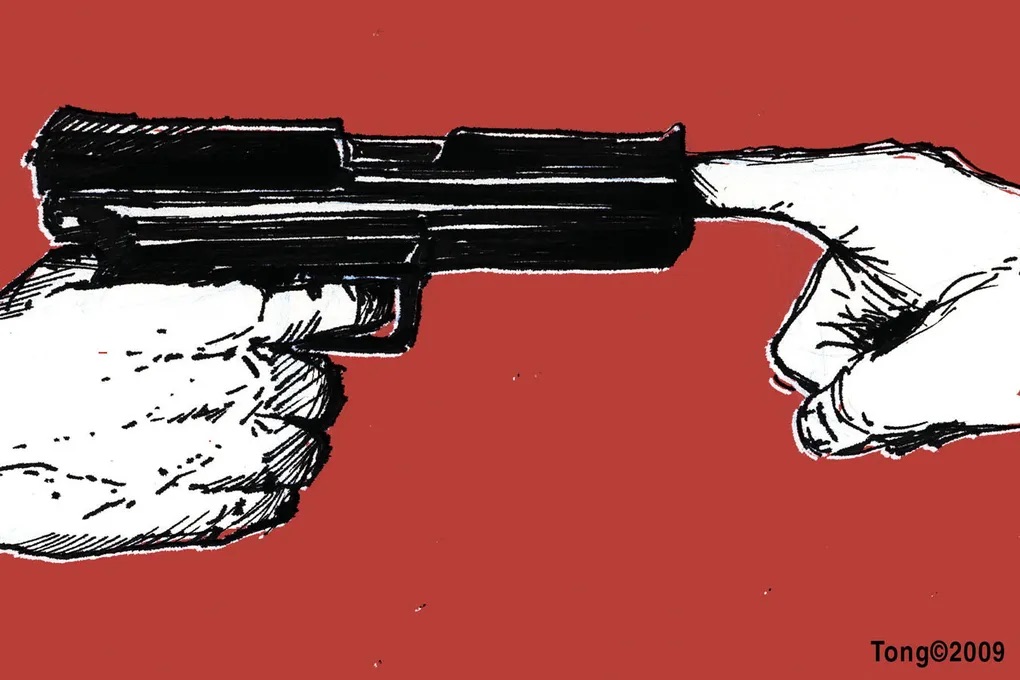
You’ve spent the last year cheering executive power expansions, fooling yourselves into believing you’ve built something that only cuts one direction. But executive power doesn’t have partisan alignment. It has temporal alignment, and it belongs to whoever holds the office next.
And that won’t always be a Republican.
As a thought experiment I analyzed the machinery Trump has already erected, just in 2025, the precedents he established, and mapped out how the next Democrat to become president could use them to gut our Second Amendment rights without passing a single law through Congress.
This matters to me immensely because I’m a lifelong Second Amendment supporter and defender, and I spent the last year watching in horror as my own side systematically fucked us over, cheering the whole way.
You can call me a radical leftist, say I have Trump Derangement Syndrome, tell me I’m being hysterical, call it hyperbolic, tell me to take off the tinfoil hat, get back on my meds, whatever. I don’t care anymore. These are the facts you’re too blind to see.
I’m just connecting the dots for you with a fluorescent green Sharpie.
And you still won’t be able to see it.
Because that’s how cults work.
This isn’t even a warning. I tried warning months ago. You excommunicated me. It’s too late for warnings anyway. The damage is already done.
Congratulations.
January 20, 2029: Inauguration Day
The new Democratic president takes office. Campaign ran hard on gun violence—the mass shooting that dominated coverage in late 2028 is still fresh in voters’ minds. Progressive base expects action. Moderate swing voters want something done.
First hundred days priority: emergency declaration.
Gun violence kills over 40,000 Americans annually. Mass shootings occur with metronome regularity. Healthcare costs run billions. CDC data provides statistical justification stronger than any trade deficit spreadsheet Trump used for tariffs. The emergency declaration practically writes itself: gun violence constitutes an unusual and extraordinary threat to national security and public health.
Executive order drops. ATF directed to halt processing of all new FFL applications pending “enhanced background review protocols.” Existing dealers face immediate compliance audits with suspension for procedural violations. Interstate commerce in firearms with foreign-sourced components—which is nearly all of them—falls under emergency authorities. Manufacturing restrictions implemented under Defense Production Act. Import bans justified under same IEEPA language Trump used for tariffs.
The text doesn’t explicitly authorize any of this. But Trump established in his April 2, 2025 “Liberation Day” tariff order that emergency statutes grant powers beyond their explicit text when presidents invoke national security. Trade deficits became national emergencies requiring IEEPA tariffs despite IEEPA never mentioning tariffs. Federal courts ruled on May 28, 2025 that Trump exceeded IEEPA authority. Tariffs remained in place during appeals. Supreme Court heard arguments November 5, 2025, decision expected sometime in 2026.
Gun violence has body counts. Which emergency sounds more credible?
Second executive order same day: novel Second Amendment interpretation. The amendment’s original public meaning, properly understood, protects an individual right only in connection with service in organized state militia structures. Private ownership unconnected to militia service falls outside constitutional protection. All executive agencies directed to implement firearms policies consistent with this understanding.
Trump did this January 20, 2025 with Executive Order 14160 on birthright citizenship. Attempted to redefine the Fourteenth Amendment via executive order, contradicting 125 years of precedent including the Supreme Court’s 1898 decision in United States v. Wong Kim Ark. Four federal judges blocked it immediately, calling it plainly unconstitutional. Supreme Court agreed to hear the case in December 2025.
The critical point to understand is Trump demonstrated a president can assert novel constitutional interpretation via executive order, implement it immediately, and force the judiciary to spend years unwinding what’s already operational. The order will probably lose. But the playbook exists.
Week One: The Injunction Theater
Gun rights organizations mobilize fast. NRA, GOA, FPC, SAF file federal lawsuits within days. Complaints are well-drafted—these are experienced litigators who’ve fought and won major Second Amendment cases. They’ll win this one too, probably.
District courts in Texas, Louisiana, Montana issue preliminary injunctions blocking the orders. Standard move. Used to work.
But June 27, 2025 changed everything. Trump v. CASA de Maryland, 6-3 decision. Justice Barrett’s majority opinion: universal injunctions exceed federal courts’ equitable authority under the Judiciary Act of 1789. District courts can only protect named plaintiffs unless they certify a class action, which requires meeting specific legal criteria and surviving multiple rounds of appeals.
Before CASA, a single federal judge could block an executive order from affecting anyone nationwide. Between January 20 and June 27, 2025, district courts issued 34 nationwide injunctions against Trump’s orders. That’s over. Post-CASA, courts can only protect named plaintiffs unless they certify a class.
Those Texas, Louisiana, Montana injunctions protect NRA, GOA, FPC, SAF and whatever members they specifically named in their complaints. Everyone else—the 50,000+ licensed dealers, the millions of Americans trying to purchase firearms, the manufacturers, the importers—remains subject to the order.
The policy operates as functional law for everyone not named in the lawsuit. Class certification requires meeting specific legal criteria, surviving appeals, grinding through months or years of procedural litigation. Meanwhile the restrictions are the reality.
Facts on the ground accumulate. Dealers close. Inventory sits. Transactions don’t happen. Manufacturing capacity relocates or ceases. Every month the policy operates, the practical landscape transforms.
By the time Supreme Court rules (now packed with Liberal justices)—two years, maybe three—the question isn’t whether to impose restrictions. It’s whether to return to the chaos before the restrictions.
Month One: Suppressing the Opposition
Gun rights organizations are the named plaintiffs blocking executive overreach. They file the lawsuits, fund the litigation, provide the legal firepower that protects Second Amendment rights.
They’re also organizations with employees, donors, board members, financial structures, tax filings, and the legal vulnerabilities any sufficiently motivated investigation finds. Everyone has something. Improper coordination. Procedural violations. Tax irregularities.
April 9, 2025, Trump issued executive orders targeting Chris Krebs and Miles Taylor—former administration officials who criticized him. Orders revoked security clearances, directed DOJ investigations, suspended clearances for their known associates. Not for crimes. For opposition.
Same day, executive order targeting Susman Godfrey—the law firm that successfully sued Fox News for Dominion Voting Systems over election fraud claims. Suspended security clearances for all firm employees, restricted access to federal buildings, directed agencies to review and terminate contracts with anyone doing business with them. Federal judge called it a “shocking abuse of power” and “personal vendetta.” Partially enjoined, never fully vacated.
Trump demonstrated presidents can direct DOJ investigations, revoke security clearances, and target organizations that oppose executive policy. Not for crimes. For opposition.
Month one, 2029: DOJ announces investigations into NRA, GOA, FPC financial practices. Not charges. Investigations. Vague allegations about coordination, improper donor disclosure, potential tax violations. Security clearances revoked for senior leadership and any government contractors doing business with them.
The goal isn’t conviction. The goal is legal fees that drain war chests, investigations that consume leadership attention, reputational damage that chills donor participation, and the message to every law firm considering Second Amendment cases that they might be next.
Trump built the template. Named the targets publicly. The next president inherits the precedent.
Month Three: The Deployment
States start refusing to enforce federal firearms restrictions. Texas, Florida, Montana, Wyoming announce they won’t comply. Governors issue executive orders protecting Second Amendment rights within state borders. Some declare state-level emergencies in response to federal overreach.
The administration characterizes this as insurrection. State defiance of federal law enforcement constitutes rebellion against constitutional order. Gun violence combined with state-level resistance creates national security threat requiring military response.
January 20, 2025, Trump declared national emergency at southern border, characterized migration as “invasion,” ordered military to “seal the borders” and “repel invasions including unlawful mass migration.” That was the template.
June 2025, Trump deployed 700 Marines and 4,000 National Guard troops to Los Angeles amid immigration protests, overriding California Governor Gavin Newsom’s objections. August 2025, two thousand National Guard troops deploy to Washington D.C. September, Portland and Memphis. October, Chicago under “Operation Midway Blitz.” December, New Orleans. Plans underway for St. Louis, San Francisco, New York, Baltimore, Oakland.
September 2, 2025, U.S. District Judge Charles Breyer ruled Los Angeles deployment violated Posse Comitatus Act, called rationale “contrived.” Deployment continued under administrative stay.
September 30, 2025, Trump addressed over 800 generals and admirals at Quantico. Told them American cities should serve as “training grounds for our military.” Described America waging “war from within”—“no different than a foreign enemy, but more difficult in many ways because they don’t wear uniforms.” Pentagon unveiled revised National Defense Strategy prioritizing domestic missions over combating Russia and China. Defense Secretary Pete Hegseth outlined plans for “maximum lethality” and weakened rules of engagement.
Pentagon established permanent Domestic Civil Disturbance Quick Reaction Force—two groups of 300 soldiers stationed in Alabama and Arizona, ready for deployment to American cities on command.
The infrastructure isn’t being built. It’s operational.
Trump’s workaround to Posse Comitatus: military deployment isn’t law enforcement, it’s national defense. Immigration isn’t civil matter, it’s invasion requiring military response. Crime isn’t policing problem, it’s insurrection requiring troops. Courts ruled deployments illegal. Deployments continued anyway.
The principle generalizes. If “unlawful mass migration” and “violent crime” constitute invasions justifying military deployment despite Posse Comitatus, “epidemic gun violence” triggers the same framework. States refusing to enforce federal firearms restrictions aren’t exercising federalism, they’re harboring threats to national security. Federal deployment isn’t law enforcement, it’s defense of constitutional order.
There are already troops in six American cities as of January 2026. Standing rapid reaction force exists specifically for domestic deployment. National Defense Strategy has been rewritten to prioritize homeland over foreign adversaries. Courts ruled it illegal. It continues anyway.
Again, the infrastructure is already operational.
Month Six: The Grind
Class certification still working through appeals. Government fights every motion, appeals every adverse ruling. Fourth Circuit sided with plaintiffs. Government appealed to Supreme Court. Supreme Court hasn’t decided whether to grant cert.
The policy operates.
Dealers facing “enhanced compliance audits” have FFLs suspended for paperwork violations that normally warrant warning letters. Some close voluntarily rather than fight. Renewal applications sit in limbo—ATF says they’re processing them, just slowly, nothing they can do about bureaucratic delays during transition to enhanced protocols.
Manufacturers with international supply chains face import restrictions on components. Some relocate manufacturing overseas where it’s easier to comply with various national regulations than navigate this emergency framework. Some cease production of affected models. Cheaper to write off the line than retool.
Secondary market prices spike. Existing inventory hoarded. Private sales still technically legal in some states but interstate transport restrictions and emergency commerce regulations make it practically difficult.
Six months in, the firearms market has contracted. Not eliminated—that would be too obvious, too actionable. Just heavily restricted under emergency authorities while courts deliberate.
Facts on the ground accumulate. Every month the restrictions operate, they normalize. Media coverage shifts from “constitutional crisis” to “new firearms framework.” Progressive base celebrates. Gun rights advocates grow exhausted fighting. Some accept the new reality.
Year One: The Transformation
Dealer network contracted by thirty percent. Small operations couldn’t survive compliance burden. Large operations consolidated. Manufacturers restructured around regulatory environment.
People adapted. Gun ownership hasn’t ended—but it looks different. More paperwork. Longer waits. Fewer options. Higher costs. The casual gun buyer frustrated by hassle stops trying. The committed gun owner persists but finds it harder.
Courts still processing appeals. Class certification granted in three circuits, denied in two, pending in four more. Circuit split means Supreme Court will eventually have to resolve. But that’s still months away, maybe longer.
The restrictions aren’t law yet. They’re emergency orders being challenged. But they’ve been operating for a year. They’re the reality people live under. Returning to pre-emergency status quo now feels like removing restrictions, not restoring rights.
Political argument shifted. Question is no longer “should we restrict firearms” but “should we end these emergency measures that have been working.” Public opinion polls differently when restrictions are already in place versus when they’re being proposed.
Year Two: Supreme Court Finally Rules
February 2031. Supreme Court issues decision. Maybe they overturn everything—Heller precedent still controls, emergency authorities don’t extend to core constitutional rights, executive overreach invalidated.
Or maybe they don’t. Heller was 5-4. Courts change. Justices retire. Constitutional interpretation evolves. Emergency powers doctrine is murky. Precedents cut both ways.
But assume the best case: Supreme Court sides with gun rights organizations completely. Orders vacated, restrictions ended, rights restored.
The landscape has already transformed.
Dealers who closed aren’t coming back. Manufacturers who relocated aren’t returning. Infrastructure that dissolved doesn’t spontaneously rebuild. Market that contracted doesn’t automatically expand. American perspective on gun ownership shifts to a heavily regulated privilege rather than constitutional right.
The restrictions might end. But the damage persists.
And the political question is changed permanently. Opponents frame restoration as “returning to chaos” rather than “restoring rights.” Even if courts rule correctly, implementation takes time. Bureaucracy moves slowly dismantling what took two years to build. Some restrictions persist through regulatory inertia. Some become normalized enough that Congress codifies them.
That’s how executive power works when courts can’t issue nationwide relief immediately, when litigation takes years to resolve, when emergency authorities operate during judicial review, when facts on the ground accumulate faster than legal remedies.
Trump built this machinery. You cheered it on. Every piece has been tested. Every precedent already established. Every tool ready and waiting for the next hand that reaches for it.
You spent 2025 celebrating these precedents because they targeted people you don’t like—immigrants, political opponents, law firms that sued your preferred media outlets. You’ve called it “finally fighting back.” You’ve called it “using their tactics against them.”
You say you’re patriots.
But you’re just useful idiots.
And you’ve tied your own noose.
Discover more from The Annex
Subscribe to get the latest posts sent to your email.

 The Annex