Sometimes I wonder what would have happened if Joseph Smith hadn’t been raised in a culture where the Roman Catholic Church was the Whore of Babylon.
Because the plain and precious truths he claimed to have restored were all ancient traditions that Protestants—not Catholics—rejected or forgot. Every single one of them. I’ve already detailed how each thing he saw as lost already exists in Catholic theology and tradition, and has, since the beginning.
That essay covered what he reinvented. Now let’s talk about why.
Bottom line upfront? My theory is Smith looked at Protestant Christianity, correctly identified that something had been lost, and then—because everything he encountered about Catholicism came through a Protestant anti-Catholic lens that had already categorized the sacramental tradition as apostasy—reinvented an elaborate replacement from scratch.
He couldn’t take from Catholic teachings and tradition because he’d been taught it was the corruption, not the preservation.
So he built new.
But he didn’t build better.
I remember the first time I watched a Catholic baptism, long before I swam the Tiber myself. It was in a tiny parish I was visiting in Hawaii, because I couldn’t stop visiting parishes no matter where I traveled.
After the water, the priest anointed the child’s crown with Sacred Chrism and said:
“God the Father of our Lord Jesus Christ has freed you from sin, given you a new birth by water and the Holy Spirit, and welcomed you into his holy people. He now anoints you with the chrism of salvation. As Christ was anointed Priest, Prophet, and King, so may you live always as a member of his body, sharing everlasting life.”
I nearly came out of the pew.
Prophet, Priest, and King. The titles conferred in the LDS temple endowment—the ceremony you can only access after passing worthiness interviews, paying a full tithe, and holding a current recommend—spoken over a baby in a parish anyone can walk into. No paywall. No surveillance system. No years of institutional compliance.
Just water, oil, and a theology that’s been there since the beginning.
The most sacred titles in Mormonism are given freely to every Catholic infant before they can hold their own head up.
The obvious counterargument—and it’s a fair one—is: if Catholics had this all along, why did it take until 1965 to say so?
The concept of all the baptized being anointed as prophet, priest, and king was codified at Vatican II in Lumen Gentium. The council’s move was to say: go back to the source texts. The common priesthood of the baptized is its own real thing, not a metaphor and not a watered-down version of ordination. The ministerial priesthood and the common priesthood differ “in essence and not only in degree,” but neither is reducible to the other. The updated 1969 baptismal rite then gave it liturgical expression.
But Vatican II wasn’t inventing anything. It was recovering something that had been underemphasized for centuries. The medieval period had increasingly concentrated the threefold office in the ordained priesthood and the hierarchy, and by the time of the Reformation, the common priesthood of the baptized was practically invisible to the laity.
But practically invisible isn’t apostasy.
The theology was never fully lost, even in the medieval period. Aquinas discusses the baptismal character as a participation in Christ’s priesthood in the Summa Theologica (III, q.63). It was underemphasized, pastorally buried, and functionally inaccessible to ordinary believers—but it was there in the theological tradition, waiting to be recovered. Vatican II was an excavation, not a revelation.
And here’s where I need to be honest, because if I’m not, I lose the people who most need to hear the rest of this.
The medieval Church was corrupt. Absolutely. No question about that. The sale of indulgences, the concentration of sacramental theology in clerical hands until the laity couldn’t access their own tradition, the political weaponization of the papacy—the Reformers weren’t hallucinating. The Protestant critique that the institutional Church had obscured the gospel from ordinary believers was substantially correct as a pastoral observation. When Luther nailed his theses to the door, he was responding to something real.
And the East did a much better job of preserving foundational truths. Theosis (and Eternal Marriage) never went underground in Orthodoxy the way it did in the Latin West. The common priesthood remained more visible in Eastern liturgical theology. The sacramental tradition stayed closer to the source. Rome’s own best recovery work at Vatican II drew heavily on Eastern sources—because the East had kept what the West had buried.
And the Church knows this. Vatican II said it plainly in Lumen Gentium: “The Church, embracing in its bosom sinners, at the same time holy and always in need of being purified, always follows the way of penance and renewal.” The council document on ecumenism went further: “Christ summons the Church to continual reformation as she sojourns here on Earth. The Church is always in need of this, insofar as she is an institution of men here on Earth.” The Reformers’ own motto—ecclesia semper reformanda, the church must always be reformed—was adopted by the institution they left. The Church agrees it needs reform. It has always agreed. It just disagrees that reform requires schism.
Fulton Sheen put it with characteristic bluntness: the Church is like Noah’s ark—full of both clean and unclean animals, and it must have had an unholy smell, but it was carrying eight persons to salvation. In other words, the ark was literally full of shit, and it needed to be mucked out regularly. But it also preserved. What Luther and the Restorationists got wrong wasn’t the diagnosis. It was the prescription. They smelled the funk and concluded the vessel was lost. But the stench was never the vessel. The vessel is what Christ founded, and the gates of hell never prevailed against it—even when the crew did their damnedest to help scuttle her (I’m looking at you Pope Alexander VI).
Frankly, I can’t think of another human institution that could survive two whole millennia of that much self-inflicted scandal and still be standing. That alone gave me pause when I was investigating. An institution that should have destroyed itself a hundred and one times over and didn’t starts to look like something more than just an institution.
So, yes, the Reformers said the institution was corrupt. That was true. They also said it was apostate. That was false. Corruption and apostasy are completely different claims. The Restorationists—Smith included—said the truths were gone. That an apostasy had occurred so total that the gospel itself had to be restored from heaven by angelic visitation and new scripture.
That’s a bold claim, and it doesn’t survive contact with the actual tradition.
The truths weren’t lost. They were buried under centuries of institutional detritus, poorly taught, functionally invisible to the laity—but present in the theological tradition the entire time. The corruption was real enough to make the “Rome is Babylon” narrative plausible. But plausible isn’t true. And the distance between “the institution is corrupt” and “the truths are gone” is the distance between reformation and reinvention.
Smith chose reinvention. Not because the truths were actually gone, but because the culture he was born into had already decided they were.
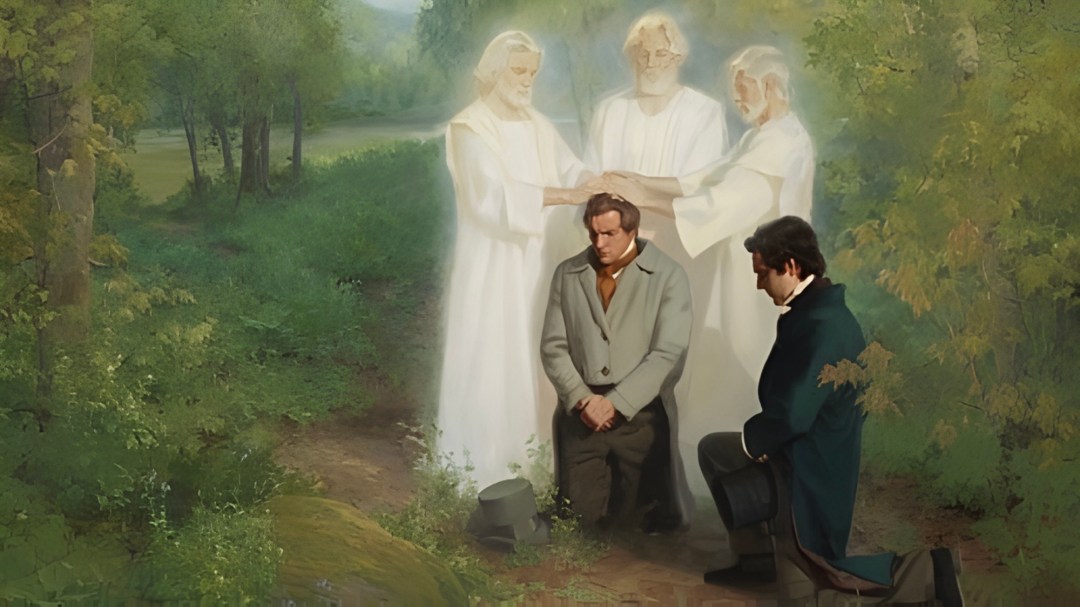
In the LDS Church, the Melchizedek Priesthood is the higher order of priesthood authority—the one that governs the Church, administers the temple ordinances, and provides the authority structure for everything from blessings to governance. It’s conferred by the laying on of hands in a specific chain of authority traced back, the Church claims, through Joseph Smith to Peter, James, and John, who received it from Christ. It’s institutional. It’s linear. It’s a chain of hands on heads stretching back through history. I actually still have the card listing my unbroken lineage from my dad back to Smith, ordination by ordination. It’s taken very seriously.
In Catholicism, the priesthood “after the order of Melchizedek” is something every baptized person already participates in. Every man, woman, and child. Not through a lineage of authority passed hand to hand, but through the baptismal chrism that configures them to Christ—who is the priest after the order of Melchizedek. The priesthood inheres in the anointing, not in the office. It’s Christological, not institutional.
That’s a fundamental difference in kind. But the real problem for the LDS model isn’t the Catholic alternative. It’s Hebrews.
The “order of Melchizedek” language in Hebrews 7 is deliberately anti-lineage. The entire point of the Melchizedek argument is that this priesthood is not passed through hereditary succession—contra the Levitical model. The author of Hebrews goes out of his way to make this explicit: Melchizedek is described as “without father, without mother, without genealogy, having neither beginning of days nor end of life.” The priesthood of Melchizedek exists because of who Christ is. Participation flows from union with Christ, not from a chain of hands on heads, not from institutional succession, and not from a lineage of authority traceable through history.
That’s the plain sense of the text. And it’s devastating for the LDS priesthood model, because Smith built exactly the thing Hebrews is arguing against.
He looked at Protestant Christianity, correctly saw that the sacramental priesthood had been stripped away. He couldn’t look to Rome because Rome was Babylon. So he constructed a new priesthood authority—one built on linear succession, institutional conferral, and a traceable chain of hands—and named it after Melchizedek. Which is almost exactly backwards from what Hebrews 7 is arguing.
Smith got close enough to recognize the shape of what was missing. He just couldn’t see the substance. Which brings us to another “restored” truth that stands hand-in-hand with the priesthood—and was never actually lost either.
The LDS temple endowment is, at its core, Catholic baptism and confirmation—dressed up in elaborate Masonic-inspired ritual. Whatever else Freemasonry carried through its history, it transmitted structural echoes of Catholic sacramental practice through its medieval guild origins—anointing, covenant-making, sacred clothing, the conferral of new names and titles, the movement through stages of initiation toward the holy of holies. These are sacramental patterns with deep roots—and you can clearly see them in their uncorrupted form in the Eastern Divine Liturgy (I was blown away by the parallels the first time I visited a Byzantine Catholic parish).
By the time that signal passed through the transition from operative to speculative Masonry, through post-Reformation English lodge culture, through early American Freemasonry, and finally to the Nauvoo Lodge in 1842—just weeks before Smith introduced the endowment—it had been degraded through multiple layers of reinterpretation. The sacramental theology had been stripped away. What remained were forms: ritual structure, symbolic vocabulary, the shape of something sacred without the theological content that originally animated it.
Smith recognized the shape. He knew it meant something. And because he couldn’t access the sacramental tradition that was the ultimate source—because his entire framework had pre-excluded it—he filled the empty forms with new content. (How much of Masonry was transmitted versus reinvented over time is debated by scholars and historians—but the parallels are too dense and too specific to be coincidental.)
He reconstructed an original he’d never seen from a copy of a copy of a copy.
But strip away the 90 minute film and costumes and handshakes and awkward touching (I hear they got rid of that) and the Endowment is really just Catholic baptism and confirmation. It’s simply an anointing as Prophet, Priest, and King with a new name. Every confirmed Catholic has that. The rest is Masonic-inspired theatre.
And it wasn’t just Smith.
The restoration narrative mirrors a pattern across the entire Second Great Awakening. The Campbellites identified a real absence in Protestant worship and tried to reconstruct New Testament Christianity from scripture alone. The Adventists identified a real absence in Protestant eschatology and built a new prophetic framework. The Shakers, the Oneida Community, the various communitarian movements—all of them were reaching for something Protestantism had stripped away, all of them shared the same anti-Catholic presuppositions, and all of them tried to leap back over 1,800 years of tradition to rebuild from scratch.
The underlying logic was everywhere: something is missing. Rome can’t have it, because Rome is the corruption. Therefore we must rebuild from the ground up.
What set Smith apart from the Campbellites and Adventists wasn’t his diagnosis. It was his method. He wasn’t just preaching a restored gospel. He was performing one. And the performance carried enough of the original signal to feel true, even though the theology underneath had been mungled.
But the blind spot was shared. The entire restorationist epistemology had a structural defect: it assumed that if the institution was corrupt, the truths it carried must be gone. That’s a non sequitur. The truths survived the corruption—not because the men running the institution deserved to carry them (I’m looking at you too, Pope John XII), but because the truths were woven into the sacraments, the liturgy, the theology itself. You’d have to destroy the tradition entirely to lose them. And nobody managed that—because Christ himself promised they would endure.
Smith couldn’t see that. Not because he was stupid—he was arguably brilliant. And not because he was dishonest—I think his spiritual experiences, while not literally God and angels descending from Heaven to restore what was lost, were genuine to him. But because the cultural air he breathed had already decided that Rome was Babylon, that the Catholic Church was the Great and Abominable Church, and that nothing true could possibly issue forth betwixt the loins of the Great Whore.
That cultural context makes his particular blind spot inevitable, frankly, rather than just idiosyncratic. He was a man with a genuine spiritual intuition operating inside an epistemological framework that had pre-excluded the answer. He reached for the right thing. He just couldn’t see where it was sitting.
The tragedy of Joseph Smith isn’t that he was wrong about everything. It’s that he was right about the most important thing—that something sacred had been lost from Protestant Christianity—and then built an elaborate, beautiful, deeply felt system to replace what was never actually gone.
It’s been here the whole time.
Discover more from The Annex
Subscribe to get the latest posts sent to your email.

 The Annex