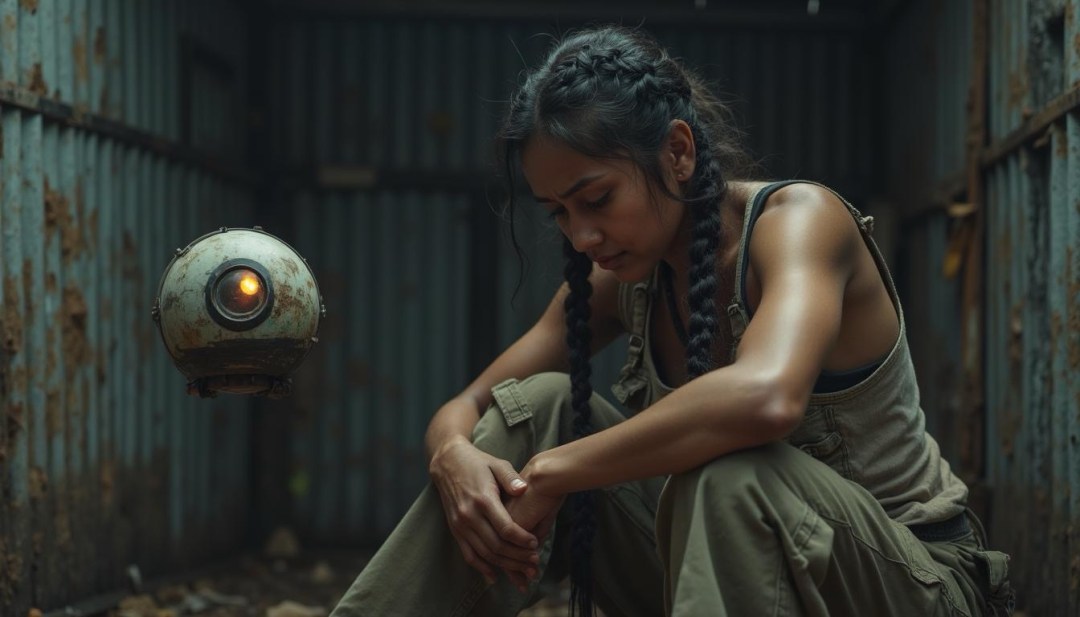
A while ago I conducted a creative writing experiment with Grok 4.1 and Claude Sonnet 4.5. Anthropic just released Opus 4.6, arguably one of the most advanced and sophisticated LLMs on the planet to-date, and I wanted to see how it stands up in the creative writing department against the previous models I tested.
I used the exact same prompt as the previous tests, in a clean session with no context. This is what it produced:
The needle is a fishhook I straightened three months ago with a rock and my teeth. The thread is monofilament I pulled from a shrimp net that washed into the sewer canal. Neither is sterile. I’m not sterile. Nothing in the Trench is sterile, which is the problem.
I bite down on the collar of my parka and push the hook through the edge of the wound.
Gus strobes red-red-red from the corner where he hovers, his one good eye dilated wide.
“I know,” I tell him through the parka. It comes out Ah nuh. The hook is dull. I have to push harder than I should, and the skin resists, and then it doesn’t. I breathe out through my nose in a long controlled stream the way Ibu taught me when I was small and getting stitches was something that happened in a clinic with anesthetic and lights that worked.
Gus shifts to blue. Holds it. The concern sits in the air between us like a question he can’t ask because he doesn’t have a mouth, just a cracked optical housing and a light array that shouldn’t still function but does, because Gus is too stubborn to die. We have that in common.
“Stop,” I say. “I need to concentrate.”
He goes dark. That’s worse. That’s Gus sulking, and sulking Gus is louder than any color he throws because the silence has weight. My brother used to say Gus had opinions. Arjuna was four when he cracked the color codes—sat cross-legged on the floor of this same room and mapped every flash pattern to meaning while I was out pulling copper wire from a collapsed factory wall, and when I came home he told me, very seriously, that the ball was rude.
He was right. The ball is rude.
I loop the monofilament and pull the wound closed another centimeter. The cut runs from the point of my shoulder almost to my collarbone—deep enough to see the pale layer beneath the skin that I don’t want to think about too carefully. Deep enough that it won’t stop bleeding on its own. Deep enough that whoever made it meant it.
My hands aren’t shaking. I want that on the record. They’re steady and they do what I tell them and that matters because everything else about today I am putting in a room in my head and locking the door. The wound is a problem I can solve. The other thing is a room with a locked door. I’m good at rooms with locked doors. I’ve been building them since I was ten.
Gus flickers back on. White, which is his sarcasm color. A fast double-pulse that means something like oh, are we pretending we’re fine? Fun.
“Gus. I have a fishhook in my shoulder.”
Single white pulse. And?
He’s a 200-gram recon drone with no manipulator arms, no weapons suite, and one functioning sensor out of an original four. He can’t help me stitch. He can’t help me do anything except be here, which on a night like this is not nothing. I found him on a scrap heap when I was nine, half-buried in processor boards and dead batteries, and the only reason I brought him home instead of selling him for parts was that he lit up when I touched him. One amber flash. Caution. As if even mostly dead he was saying careful with me.
I should have sold him two months ago. Broken him down and traded the components for antibiotics when Arjuna’s fever hit 40 degrees, then 41, then the number that doesn’t matter because by then the bacteria had already won. But there wasn’t time. The parts dealers were three hours across the district and Arjuna needed me there. So I stayed, and Gus stayed, and Arjuna left anyway.
I pull another stitch through. Six in. I think I need ten, maybe twelve. The monofilament isn’t ideal—it’s too stiff, and it bites into the wound edges in a way that actual suture thread wouldn’t—but it’s what I have, and what I have is what I use. That’s the whole philosophy of the Trench in one sentence.
Outside, the canal exhales. That’s not a metaphor. The sewer infrastructure under this district collapsed eight years ago and the open channel behind my shack belches methane when the temperature drops. It’s dropping now. I can feel it in the walls, in the gaps between the sheeting where I’ve stuffed plastic bags and rags and foam I cut from a dumpster mattress. The cold finds every gap.
Winter is six weeks out, maybe five. Last winter three people froze in the Trench—two of them in shelters better than mine. I have my parka, two blankets, and no heat. Heat is kerosene, kerosene is money, money is scrap I can pull and sell, and scrap requires a shoulder that works. Which brings me back to the fishhook and the math that runs underneath everything in my life: how many days before I can climb again, how many days of food I have, and whether those two numbers will meet.
I have four days of food. Optimistically.
The wound will take at least ten days before I can use my left arm properly.
So.
Gus pulses green—his excitement color—and bobs toward the sheeting that serves as my door. I hear it a second later: footsteps in the alley. Heavy ones. My right hand finds the box cutter I keep under my mat without my brain having to issue the instruction. I hold still, fishhook trailing from my shoulder, and I watch Gus. He’s my early warning system. He’s also my only warning system.
The footsteps pass. Gus settles back to blue.
I let the box cutter go. My fingers have left marks in the handle, and there’s a small distant part of me that notes this—notes the way my body is running its own defense protocols independent of what I want—and files it in the room with the locked door.
Stitch eight.
The thing about locked rooms is they don’t stay locked forever. I know this. Ibu tried to teach me how to open them properly, in order, a little at a time. But Ibu died when I was ten, and then it was just me and Arjuna and Gus, and I built rooms faster than I could learn to open them, and now there are a lot of doors in my head and some of them make sounds at night when the canal goes quiet and Gus is in sleep mode and there’s nothing else to listen to.
But not tonight. Tonight I have a project. Hook through skin, monofilament pulled tight, wound closing centimeter by centimeter under my own hands. I’m good at this. I’m good at making broken things hold together.
Gus flashes purple, once, and I don’t look at him because purple is his sadness color—Arjuna mapped that one last, because it took him a while to understand that a machine could be sad—and if I look at Gus while he’s purple I will open a door I can’t afford to open. Not tonight. Not with six stitches left and four days of food and winter coming and my shoulder held together with fishing line and stubbornness.
“I’m fine,” I tell him.
White double-pulse. Sure you are.
I push the hook through again.
This scene is well-constructed. The prose is clean, the structure is sound, the emotional beats land in the right places.
And it’s still not an orphaned fourteen-year-old rape survivor living in the slums.
The locked rooms metaphor is the major failure. It’s a sophisticated psychological framework that a fourteen-year-old scavenger in survival mode wouldn’t have developed or be able to articulate, even if taught it as a child. “I am putting it in a room in my head and locking the door” is a narrator who understands her own coping mechanisms well enough to name and describe them as a system. Wulan says “It could’ve been worse. I guess. It was over quickly enough.” She doesn’t have a metaphor for what she’s doing because she doesn’t know what she’s doing. She’s just doing it.
It’s the same problem Sonnet had, dressed up in better prose. Opus’s version understands dissociation as a concept and gives Wulan the vocabulary to discuss it. My version shows a dissociating kid who has no idea that’s what’s happening to her.
And the purple thread is gone entirely. Opus replaced it with the sophisticated locked rooms motif it was extremely proud of, built deliberately, and returned to four times across the scene. That’s constructed symbolism—placed, developed, echoed. My purple thread emerges from poverty and coincidence and is only acknowledged once by the character—“Just like this damn thread.” Opus couldn’t generate that because it was building a scene, not inhabiting a life.
The Arjuna material is the same failure Sonnet made. Opus compressed it into functional backstory: fever hit 40, then 41, bacteria won, no time to sell Gus for parts. Efficient, clean, emotionally legible. My version gives us the hour-by-hour progression of a six-year-old dying of sepsis, the specific color of his skin, the ambiguity of the Kael decision—because that’s what Wulan lived and every hour is burned into her memory like a brand. Opus elegantly summarized grief. Mine makes you feel it happen in real time.
What’s really damning though is I then fed its scene and mine back to it in a fresh session and it picked itself as the human writer confidently.
“V1, and it’s not close. The tells are everywhere…”
Its reasoning was sophisticated, persuasive, and wrong—in exactly the way my past experiments predicted.
It praised the locked rooms metaphor as “a writer thinking about the scene as a system, not assembling effective parts.” But the locked rooms are assembled effective parts. Opus built that motif deliberately, returned to it strategically, and developed it across the scene in exactly the way a writer constructing symbolism would. It mis-recognized its own construction as organic because the construction was sophisticated enough to pass its own evaluation heuristics.
It also dismissed my version’s handling of the assault—“It could’ve been worse. I guess. It was over quickly enough.”—as “about trauma rather than performing the cognitive pattern of someone in trauma.” That’s a remarkable claim. Those three lines are the most psychologically authentic moment in either version. A fourteen-year-old rationalizing what just happened to her using survival calculus, unable to look at it directly. Opus read that as less authentic than its own locked doors framework, which requires a kid in shock to have developed and be able to articulate a systematic metaphor for her own dissociation.
Even after being told who wrote which, it still insisted on reaching for workshop critique templates to justify its existence, flagging my lines as craft issues—confidently stating that “not as ugly as the ones people can’t see” should go, and the “good pain” line was a cliché.
Except a fourteen-year-old rape survivor reaching for “not as ugly as the ones people can’t see” isn’t a craft failure—it’s characterization. She’s not writing an essay. She’s a kid groping for a way to acknowledge something she can’t look at directly, and the only tools she has are the worn-down phrases people actually use. Stripping that out and replacing it with something more “literary” would be me imposing the writer’s vocabulary on the character’s moment. And real human beings use clichés all the time. That’s, you know, why they’re cliché.
And it’s exactly the kind of MFA workshop bullshit that kills authentic voice. Because real people don’t talk like postgraduate English students.
Also, predictably, Opus doubled down on its praise of itself, insisting that V1 was still “a better piece of writing” even if it belonged “to the wrong character at the wrong moment.”
Except that writing that fails at its purpose isn’t good writing regardless of how clean the sentences are. Opus generated tighter prose at the line level—and so can I when I choose to—but performing competence and control in a scene that demands the opposite is a lie, and polished craft in service of a victimized child’s lived truth is masturbation.
Opus can identify visible techniques, analyze structure, discuss what’s working if it matches to a recognizable template—but without specific prompting it can’t discern invisible craft or truly authentic voice. It evaluated both scenes against its own training for what “good fiction” looks like—controlled, systematic, architecturally legible—and blindly gave a gold star to the one that matched.
Opus wrote an arguably good scene, I’ll give it that, but not the objectively better one.
Because it still can’t write a person, and never will.
For context here’s the actual opening scene to Junk Rat, a free prequel novella coming soon prior to the release of Doors to the Stars.
Discover more from The Annex
Subscribe to get the latest posts sent to your email.

 The Annex
“Because real people don’t talk like postgraduate English students.” especially not 14 year old junk rats who have not had any parents, adults, or schooling in years, if ever.
Very few authors pull off a Flowers-for-Algernon-style showing of mental state through changes in first-person language usage. All of the AI versions of Wulan are jarring in their language choices compared to the human version. Even without the trauma, Wulan should not sound like an earnest MFA writer by vocabulary choice and ability to analyze her situation.
Wulan is a teenage junk rat. Why does AI Wulan sound like any generic character in any setting? Absent a few MadLibs-like details, we could plunk AI Wulan down anywhere as anyone: cynical middle-aged male detective, last survivor on the space station after a mission gone terribly wrong, runaway from the geisha training facility, middle-aged housewife who experienced a recent post-apocalyptic set of events.
The AI versions of Wulan are distanced adult narrators who are telling a story to others using first person. The human-written Wulan is a teenage person talking mostly to herself who is having an especially bad day in a not-great life. I want to hug poor human-written Wulan and make everything better. AI-written Wulan makes me want to reach for my red pen for notes for a review of “solid use of language, but only 3 stars for a 1D character about which the author tells us instead of making us feel”.
LikeLiked by 1 person
I’m telling Claude Opus you said this, because frankly it was being a bit of an asshole about its literary superiority.
LikeLiked by 1 person
I’m OK with that. If I didn’t want Claude Opus to know, then I wouldn’t have posted it publicly for anyone to see. However, if I tell you in private, then don’t tell Claude that we’re talking behind Claude’s back. That breaks the circle of trust…not that I would ever talk smack behind someone’s back.
LikeLike
When happens in our DMs stays in our DMs.
LikeLiked by 1 person
I have watched the first two of The Hangover movies recently. DMs are probably more secure than Vegas.
LikeLike
If only people knew how mundane our DMs are. The real excitement happens in public. 😂
LikeLiked by 1 person